Digital Transformation of Materials Science

In materials science, complex relationships exist between the properties of materials and their composition and processing. For this reason, digital transformation in this domain presents a particularly great challenge.


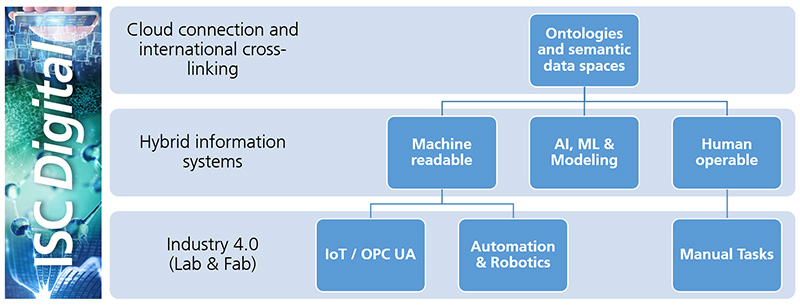
At Fraunhofer ISC, we are facing this challenge with a broad-based strategy that closely links work at all relevant levels. In this context, we have set ourselves the goal of developing toward Lab 4.0, documenting scientific processes in a central information system in a way that can be read by machines, and standardizing data structures in accordance with international standards.


Developing better materials faster: Materials Acceleration Platforms (MAPs)


At ISC, there are already several MAPs projects on different materials and related processes. We not only develop the appropriate IT infrastructure but also develop the robotic hardware. We are glad to advise companies on the first steps in this new innovative field.
 

More about MAPs

LAB 4.0

APRONA Case Study
© Fraunhofer ISC

The laboratory is the most important source of new data from experiments and measurements. Many procedures involve a great deal of work and require exact repetitions. We are therefore working on interlinked laboratory equipment and systems in order to automate work steps as far as possible. Work that, due to its complexity, can only be performed by employees is supported by partially automated documentation. At the same time, the focus is still on humans in orchestrating the complex overall process.


AI driven Lab 4.0 (PDF)

Hybrid Information Systems and Data Space

Interface LAB 4.0
© AdobeStock

No matter where data comes from or where it is processed, efficient and seamless workflows require that everyone involved is connected through a shared information system.

With Open Semantic Lab (OSL), we provide an open, hybrid knowledge and data platform that brings together information from multiple sources into one single intelligent system, accessible and usable for both humans and machines.

At its core, OSL is based on the Object Oriented Linked Data (OO-LD) concept, which simplifies the handling of complex data models and enables information to be linked and represented in a meaningful, context-aware way. Ontologies and knowledge graphs are available out of the box, so users don’t need to dive deep into IT structures or data formats like JSON.

Thanks to its modular design, the platform can be easily tailored to a wide range of use cases, from research projects to industrial data spaces. As an open-source solution (AGPL-3.0), OSL encourages collaborative development and supports the implementation of the FAIR Data Principles in science.

Artificial Intelligence

Privacy warning

With the click on the play button an external video from www.youtube.com is loaded and started. Your data is possible transferred and stored to third party. Do not start the video if you disagree. Find more about the youtube privacy statement under the following link: https://policies.google.com/privacy

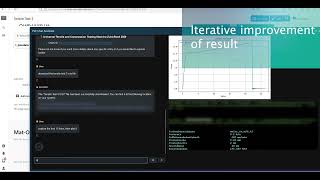
With OpenSemanticLab, we have a powerful platform for capturing and linking information. However, manually entering and analysing data is labour-intensive and often presents a barrier to adoption. That is why we are developing agentic AI solutions that automatically structure data from various documents and store it in the OpenSemanticLab knowledge graph.

Additional agents enable autonomous searching and analysis of existing data, including the generation of reports and diagrams. These technologies are applied, for example, in the area of efficient material substitution.

Ontologies

Digitization ontologies
© AdobeStock

Ontologies are formal descriptions of concepts similar to vocabularies. They can define complex machine-readable relationships and thus provide the basis for a close and uniform linkage of information in the data space. Ontologies are coordinated and continuously developed on an international level.

We are particularly active in ontology development in the area of batteries (BattINFO - Battery Interface Ontology, BVCO - Battery Value Chain Ontology), but we are also driving the development of general ontologies aligned with material development processes (GPO - General Process Ontology).

Activities and Projects


Project DiMaWert

Digital building block for the energy transition


Project KIProBatt

Intelligent battery cell manufacturing with AI-supported process monitoring based on a generic system architecture


Project BIG-MAP

Invent how to invent:
BIG-MAP for accelerated battery development