 Fraunhofer Institute for Silicate Research ISC
New Food Packaging for Improved Recyclability

The European Union’s new Packaging and Waste Regulation (PPWR) has been in effect since August 12, 2026. It gradually introduces requirements for the recyclability of packaging placed on the market in the EU. Many types of food packaging consist of multilayer films containing diverse types of plastics, which are challenging to recycle. In the “MOBILE” project, a team from industry and research developed recyclable barrier films that meet the packaging industry’s requirements and perform better in life cycle assessments than conventional comparable films. The German Federal Ministry of Food and Agriculture (BMEL) and the German Federal Ministry of Agriculture, Food and Regional Identity (BMLEH) funded the project.
Food should reach consumers from the producer in a well-protected state. Transportation and storage place high demands on food packaging. It must preserve freshness and flavor while protecting food from germs and contaminants. In many cases, plastic packaging is virtually irreplaceable and also plays a key role in preventing food waste. To ensure that all requirements (barrier properties, sealing, mechanical stability, puncture resistance and tear resistance) are met, these films often have a very complex structure and consist of multiple layers of different plastics. However, such packaging made of many different material layers is difficult to recycle because the materials are challenging to separate.
Packaging Waste by the Numbers
At around 30 percent, packaging waste accounts for a large share of the annual volume of plastic waste worldwide[1] , which corresponds to approximately 140 million metric tons per year. As early as 2022, the United Nations resolved to draft a legally binding global agreement to combat plastic pollution. Yet, the path to achieving this remains challenging. In its 2023 report on the state of plastic pollution[2] , the United Nations Environment Program (UNEP) estimated that plastic packaging loses 95 percent of its value after a single use cycle. The UNEP called for advancing the circular economy for plastics, particularly reuse and recycling. The same report estimates the total amount of short-lived plastic—such as that from plastic packaging, consumer goods and personal care products—at 238 million metric tons annually. The proportion of recyclable plastic is estimated at only 21 percent. Therefore, the goal must be to significantly improve recyclability. The European Union’s (EU) new Packaging Regulation is an important milestone in this regard.
A Material Concept for Better Recycling: Monofilm and a Thin Barrier Layer
Materials research points to an economically and ecologically sound way out of this situation. Funded by the German Federal Ministry of Agriculture, Food and Regional Identity (BMLEH) and coordinated by the Fraunhofer Institute for Silicate Research ISC, a project team comprising industry and research partners has developed, as part of the MOBILE project, a packaging film consisting of at least 95 percent of a single base polymer.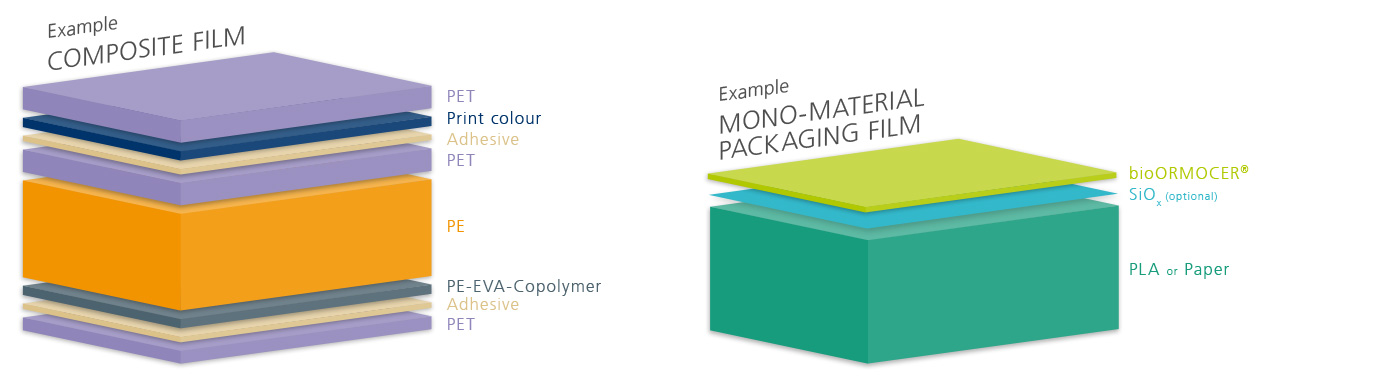
Monofilms made from the polyolefins polypropylene (PP) and, for a second demonstrator, polyethylene (PE) serve as the base material. These monofilms—that is, films made from a single material—feature a very thin coating that provides the film with the necessary impermeability to water vapor and oxygen. “The key to success was that the coating materials used were optimally matched to the film substrate and could be applied so thinly that they do not interfere with the recycling process,” explains project manager Dr. Ferdinand Somorowsky of Fraunhofer ISC.
Coatings Improve Protection Against Gases and Aroma Loss
As a barrier layer, the materials researchers at Fraunhofer ISC worked on special formulations from the ORMOCER® class of materials[3] . These can be used to produce thin coatings that not only adhere well to the actual packaging film but also provide an intrinsic oxygen barrier.
These ORMOCER® layers consist of an inorganic and a polymeric network that are bonded at the molecular level. This allows the properties of both material types to be combined, thereby linking a high barrier effect and chemical resistance with high flexibility and functionality. Since the ORMOCER® layers also produce an extremely flat surface, they can serve as a base for a final thin ultra-barrier layer, e.g., made of silicon oxide (SiOx) or aluminum oxide (AlOx).
The team applied these barrier layers to polyolefin films manufactured with up to 45 percent recycled content. After lamination with a sealing layer made of the same polymer type, the researchers thoroughly characterized the films. Mechanically, the recycled films are comparable to those made from virgin material, and the achievable barrier performance falls within a range relevant for many food applications.
The performance of the new films is excellent, as confirmed by a comprehensive life-cycle assessment.
Due to the thinness of the barrier layers (< 5 percent foreign content) and the base film consisting of a single polymer, the project partners preserved the recyclability of the barrier film. To investigate and verify this, the project partners Etimex, Constantia and Leeb manufactured standard tubular bottom bags, which Töpfer Babywelt then filled. Fraunhofer Institute for Process Engineering and Packaging IVV recycled these bags, and the team extruded a new film from the recycled material. The films underwent extensive characterization to clarify any potential effects of the recycled content. Based on the test results, the study demonstrates that this coating and processing method preserves recyclability. The mechanical properties of the film produced with recycled content remain largely unaffected. However, the appearance shows minor imperfections such as speckles (small surface defects caused by impurities) and pinholes (small crater-like indentations on the surface), which can also slightly affect the barrier effect.
The MOBILE team overcame technical challenges and conducted a life-cycle environmental assessment in reference to DIN EN ISO 14040 and DIN EN ISO 14044. These standards assess the potential environmental impacts of a product system throughout its entire life cycle. They also specify the methodology for assessing environmental impacts. This includes the analysis of raw materials, energy consumption, emissions and waste. In terms of greenhouse gas emissions in carbon dioxide (CO₂) equivalents, as well as energy and water consumption, the values for the new barrier monofilms were significantly better than those of conventional packaging films.
Project Team Across the Value Chain
The project consortium—comprising film manufacturers, the packaging industry, applied research and expertise in conducting life cycle assessments—covered the entire value chain, thereby creating favorable conditions for the market launch of the new packaging solutions.
The Fraunhofer Institute for Silicate Research ISC coordinated the project and carried out material development for the optimized hybrid barrier layers with good recycling properties. Project partner Constantia Flexibles contributed its expertise in the development, manufacture and processing of polyethylene (PE) films, optionally with an aluminum oxide (AlOx) coating. Etimex complemented the consortium with sterilizable polypropylene (PP) films for pharmaceutical applications. JenCaps Technology optimized silicon oxide (SiOx) barrier coatings at atmospheric pressure. Leeb handled the lamination of the PP films as well as mechanical analyses.
Fraunhofer-Institut für Verfahrenstechnik und Verpackung (IVV) assessed the recycling potential and conducted material analyses—particularly permeation analyses—as well as the evaluation under food safety regulations. EuraAG contributed life cycle assessments and a sustainability evaluation throughout the project. Zentrum für Lebensmitteltechnologie und Verpackung (ZLV) was responsible for public relations as well as practical packaging trials using demonstrator packaging.
[1] Organisation for Economic Co-operation and Development (OECD) Global Plastics Outlook Database, https://doi.org/10.1787/c0821f81-en.
[2] United Nations Environment Programme (UNEP): Turning off the Tap—How the World Can End Plastic Pollution and Create a Circular Economy, © 2023 UNEP, ISBN: 978-92-807-4024-0
[3] ORMOCER®: a registered trademark of the Fraunhofer-Gesellschaft zur Förderung der angewandten Forschung e. V.
Last modified: